
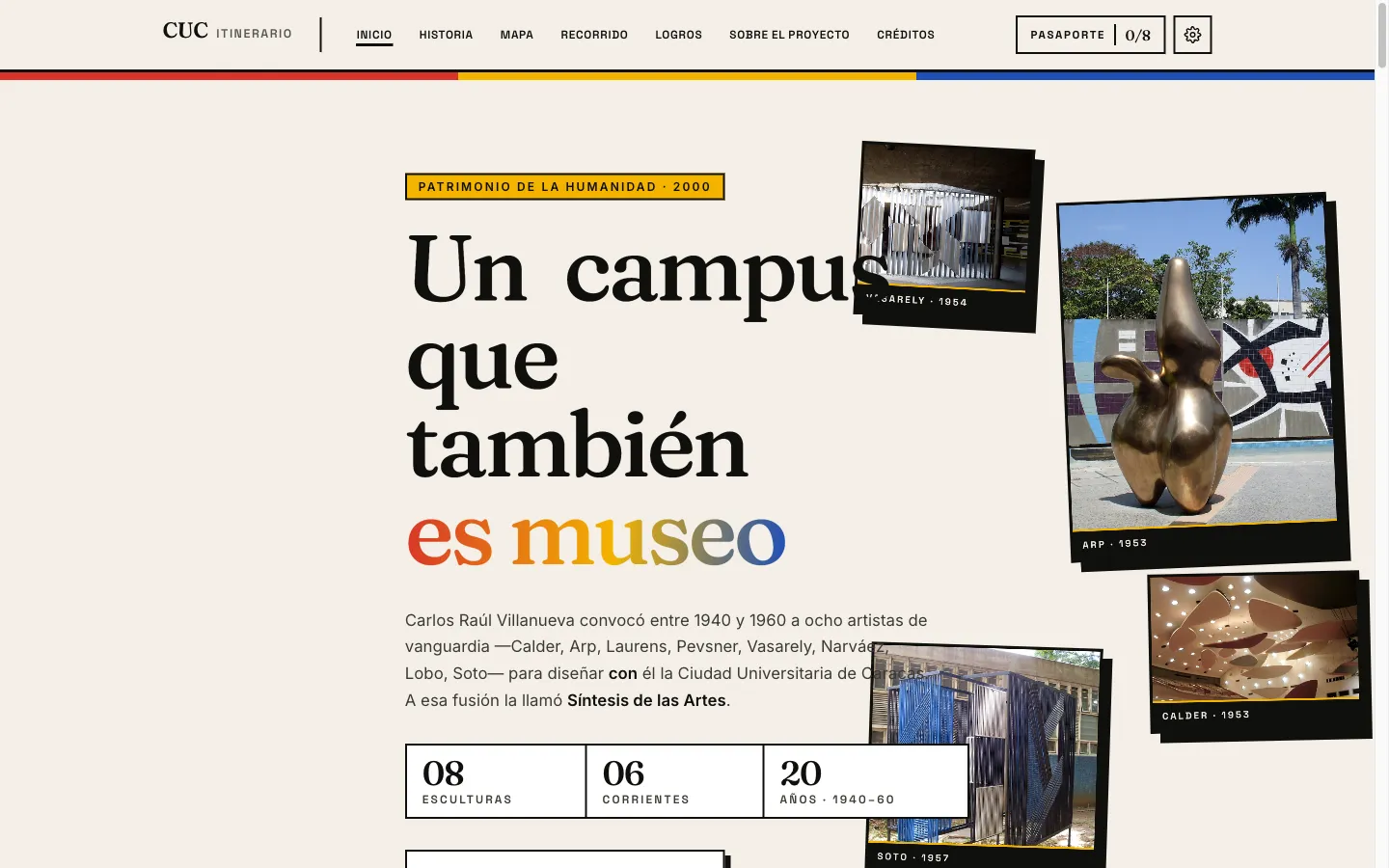
2026 · Design & full-stack development
Itinerario Virtual CUC
Educational resource on the sculptural heritage of Caracas' University City (UNESCO)
- Astro
- Preact
- Tailwind CSS
- Content Collections
- Zod
- Satori
- jsPDF
- ImageKit
- Home LCP
- 192 ms
- Accessibility
- WCAG 2.2 AA · 0 issues
- Content
- 8 stops · 9 mini-games
Context
A virtual educational resource on the sculptural heritage of Caracas’ University City — Carlos Raúl Villanueva’s masterwork, a UNESCO World Heritage Site since 2000. It’s my Master’s thesis for the Teacher Training Master’s (University of La Laguna), built for high-school Art History students and their teachers, with classroom material aligned to Spain’s LOMLOE curriculum.
The pedagogical challenge: turn eight sculptures by masters like Arp, Calder, Vasarely and Soto, plus the “Synthesis of the Arts” concept, into an experience a 16–17 year-old can navigate alone, in class or projected on screen.
Architecture decisions
- Static Astro first. Content leads: 38 prerendered pages, with Preact reserved for the islands that truly need interactivity — the mini-games — and nothing else.
- Content Collections + Zod as the typed source of truth: 8 stops, 8 artists and 6 art movements as validated markdown, plus data collections for bibliographic sources (29 references) and a timeline of events (24) as typed data.
- On-demand 3D: models (via Sketchfab and
model-viewerfrom CDN) load only on the stops that have a real model, so the rest pay no weight penalty. - Dynamic OG images generated at build with Satori (14 1200×630 cards) so each stop shares with its own cover.
- Structured SEO with seven JSON-LD types (
LearningResource,VisualArtwork,TouristAttraction,ItemList,BreadcrumbList,3DModel,WebSite), sitemap and robots.
What I built
- A bespoke design system (CSS tokens, self-hosted variable fonts) with two keyboard-switchable modes: Explorer for solo study and Presentation for classroom projection.
- 8 stop pages with artwork, artist, 3D model and observation questions with answer saving.
- 9 mini-games as Preact islands: eight “author’s gestures” — one per stop, unlocked when you seal it — that reconstruct each master’s visual language (Calder’s mobile balance, Soto’s kinetic interference, Vasarely’s alphabet…), plus a “Growing Constellation” that evolves across the route. They share infrastructure: a deterministic PRNG, a hint system, haptics, SVG export and
prefers-reduced-motionsupport. - An original photo essay of 28 works across sculptures and murals, with field research and ~60 photos served signed and watermarked via ImageKit.
- Classroom material: a teachers’ page with a seven-session LOMLOE sequence, rubrics, a UDL sheet and the thesis download; a short 4-stop session for a 50-minute class; and the “Curator’s Challenge”.
- An interactive campus map with pan, zoom and a scale bar that recomputes, a scroll-snap Villanueva timeline, a findings notebook and a “Gaze Profile” exportable to PDF (jsPDF) as assessable evidence.
- A progress-and-reward system: a catalogue of 16 credentials, gold seals and hint/time logging, all persisted in
localStoragethrough a typed, Zod-validated wrapper. - A glossary with hover definitions injected into the markdown by a remark plugin across 54 terms.
Technical challenges
Balancing interactive richness against performance was the core tension. Moving the mini-games from vanilla to Preact islands let them share a common base (reproducible randomness, accessibility, export) without giving up a site that stays static in everything that isn’t a game, loading interactivity only when it scrolls into view.
Accessibility was treated as a requirement, not an add-on: keyboard navigation, native inert for modals, 44×44 px touch targets and ≥ 4.5:1 contrast, audited with axe-core down to zero violations on key pages.
Result
On the audited home page, a 192 ms LCP — well under Google’s threshold — with near-zero CLS and zero WCAG 2.2 AA violations. A resource a teacher can project and a student can explore alone, on any device.
In short
- What is Itinerario Virtual CUC?
- Master's thesis built in Astro on the sculptures of Caracas' University City — 8 stops with 3D models, 9 mini-games as Preact islands, an original photo essay and classroom material. Zod-typed content, 192 ms home LCP and zero WCAG 2.2 AA violations.
- What is Itinerario Virtual CUC built with?
- Itinerario Virtual CUC is built with Astro, Preact, Tailwind CSS, Content Collections, Zod, Satori, jsPDF and ImageKit. Carlos Ponce delivered it in 2026 — Design & full-stack development.
- What stands out in Itinerario Virtual CUC?
- Home LCP: 192 ms. Accessibility: WCAG 2.2 AA · 0 issues. Content: 8 stops · 9 mini-games.
- Is Itinerario Virtual CUC live?
- Yes. Itinerario Virtual CUC has been live at itinerariocuc.onrender.com since 2026.