
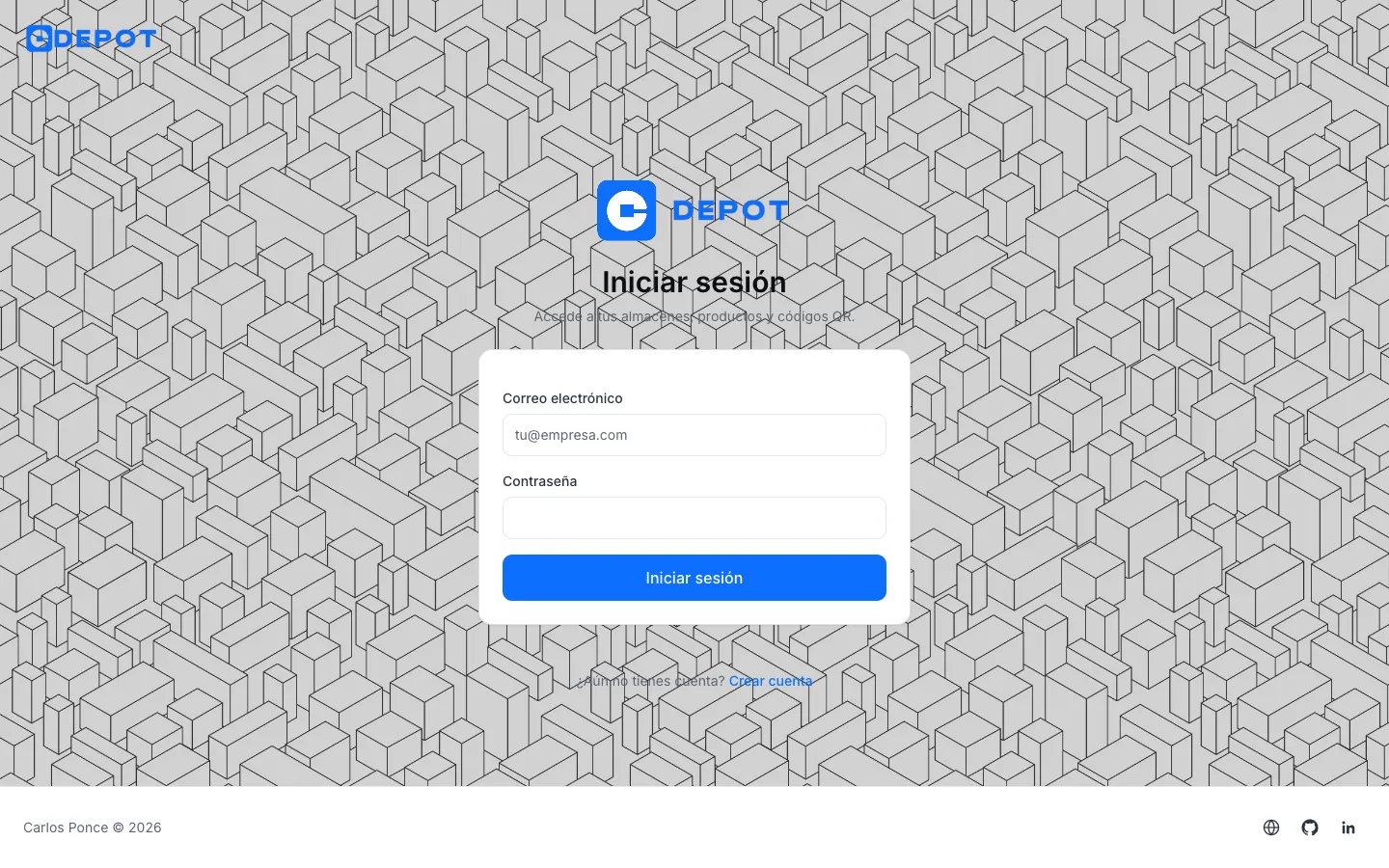
2024 · Full-stack developer (Laravel)
Inventory Management System
Multi-warehouse inventory with QR codes, roles and per-user isolation in Laravel
- Laravel 10
- PHP 8.2
- Alpine.js
- Tailwind CSS
- Cloudinary
- PHPUnit
- Docker
- Multi-tenant
- Isolated per user
- Identification
- Unique QR per product
- Quality
- PHPUnit tests + Pint
The problem
Tracking stock spread across several physical warehouses without scattered spreadsheets: knowing which product exists, where, in what state, and being able to locate it by scanning a label. The target users are small and medium businesses (retail, logistics, depots) where each manager needs their own inventory, isolated from everyone else’s.
Architecture decisions
- Laravel 10 + Blade + Alpine.js, no heavy SPA. Vite for asset bundling. Just-enough interactivity (filters, scanner) handled with Alpine, without a client framework’s cost.
- Multi-tenancy by
user_id: every query is scoped to the user instead of a schema-per-tenant setup. Simple to reason about and to test. - Cloudinary for product images: external storage and CDN, automatic transformations, no load on the app server.
- Unique QR codes generated on the model’s
creatinghook, exportable to PNG/SVG and scannable from the browser camera to locate a product instantly. - Auth with Passport + Sanctum: OAuth2 tokens with a future mobile client in mind, plus sessions for the web panel.
- SQLite in development, MySQL/PostgreSQL in production; reproducible deploy with Docker (PHP 8.2 + Apache) and automatic migrations.
Data model
Users (with admin or operator role) own products, warehouses and categories. Each product belongs to a warehouse (N:1), is classified into several categories (N:M via a pivot table), has a state (in stock, with incident…), a unique QR and its images on Cloudinary.
Security hardening
The most interesting work wasn’t adding features — it was closing gaps. I documented and fixed a batch of findings:
- IDOR: edit, detail and status-change queries are scoped by
id_userso nobody can reach another user’s products. - Cross-tenant contamination: an isolation test (
CrossTenantIsolationTest) verifies a user never sees another’s data. - Controlled mass assignment (
$request->only(...),id_useroutside$fillable), rate limiting on login/signup/QR, and token revocation on logout.
Result
An app that manages real multi-warehouse inventory, with physical QR identification and strict data separation between users, covered by feature tests (auth, QR, roles, isolation) and reproducibly deployable with Docker. The emphasis: secure by default, not just functional.